Aerodrome Control Service
Available ATC Positions
DELIVERY [DEL]
Clearance delivery position is responsible for providing ATC clearances and meteorological information to departing flights.
OPERATION COORDINATOR "PLANNER" [P_DEL]
Planner position is not a standard position. Planner’s responsibilities include slot assignment and coordination with Delivery.
GROUND [GND]
Ground position is responsible for general management of ground traffic in maneuvering area of the aerodrome.
TOWER [TWR]
Tower position is responsible for providing service within the CTR and control of flights during operations on the runway.
Aerodrome traffic control is provided according to the procedures for aerodrome control service, described in detail in chapters 6 and 7 of ICAO Doc 4444. The most important information and procedures are described in the following Operations Manual both in general (to be used in all controlled aerodromes) and in detail (including local procedure deviations for aerodromes).
Aerodrome control using surveillance systems
TWR with surveillance systems
In FIR Warszawa surveillance systems are available at the following positions:
- TWR Gdańsk,
- TWR Katowice,
- TWR Kraków,
- TWR Modlin,
- TWR Okęcie,
- TWR Poznań,
- TWR Wrocław,
- TWR Rzeszów.
* Only within CTR Rzeszów to use as assistance for VFR flights. In absence of APP Kraków after leaving CTR Rzeszów TWR controller must terminate radar service.
Tower control procedures
Runway in use selection
Runway selection is performed according to the following Runway Selection Preference System:
- based on wind direction
| Wind direction | Runway |
|---|---|
| 0 - 10 kts | Runway selected regardless of wind direction |
| 10 - 20 kts | Runway selected closer to “against the wind” direction, unless other conditions determine otherwise* |
| > 20 kts > G25 kts | Runway selected “against the wind” direction regardless of other weather conditions and preferred RWY** |
* at EPWA, two runways are selected for use in accordance with the preference system.
** at EPWA, one runway is selected for both takeoffs and landings.
- runway equipment
- LVP equipment and procedures (ILS CAT II/III, RNP AR APCH),
- equipment and procedures for precision landing (ILS),
- equipment and published procedures for non-precision landing,
- runway condition,
- safety reasons.
Departure separation
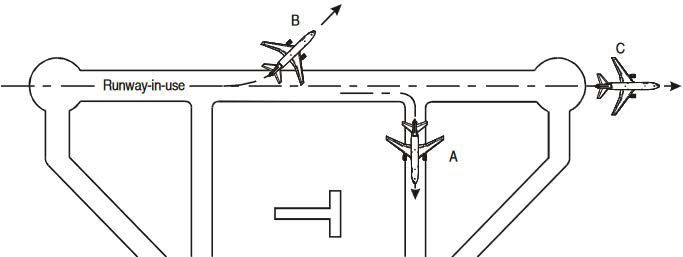
Clearance for take-off may only be issued when no other aircraft is in front of the departing aircraft on the runway. Final positions that must be reached by arriving aircraft (A) or departing aircraft (B or C) before an arriving aircraft can be cleared to land of a runway in use or a departing aircraft can be cleared for take-off:
Separation of departing aircraft:
- based on a surveillance system:
- 3 NM - departures in different directions/different SIDs,
- 5 NM - departures in the same direction/same SID,
- 5 NM - departures in different directions/different SIDs, when the preceding aircraft is 40 kts or more slower than the succeeding aircraft,
- based on time:
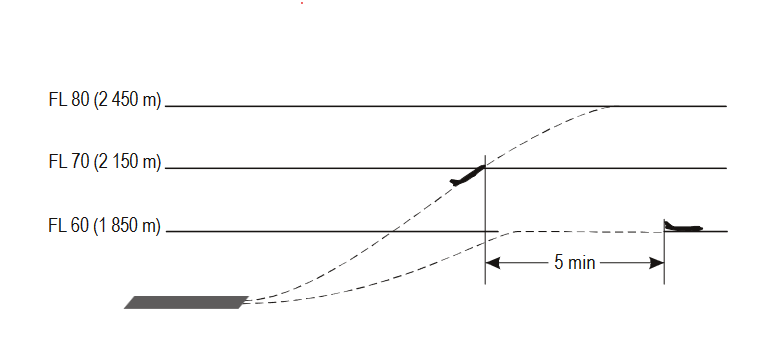
- 5 minutes - between departing aircraft on the same track, if the following aircraft will be crossing the level of the preceding aircraft,
- 2 minutes - between departing aircraft on the same track, when the preceding aircraft is at least 40 kts faster,

- 1 minute - between departing aircraft, when the departure tracks differ by no less than 45°,

- based on visual observation (VFR)
- aircraft has started a turn or passed departure end of runway.
Departures from intersecting runways are subject to common departure separations (requires usage of same separations as departures from the same runway).
Departure wake turbulence separation
In addition to standard established separations, an important factor is the consideration of wake turbulence of departing aircraft of different categories:
- The same starting point of the take-off run:
| Preceding | Suceeding | Separation |
|---|---|---|
| SUPER (J) | HEAVY (H) | 2 min |
| SUPER (J) | MEDIUM (M) | 3 min |
| HEAVY (H) | MEDIUM (M) | 2 min |
| SUPER (J) | LIGHT (L) | 3 min |
| HEAVY (H) | LIGHT (L) | 2 min |
| MEDIUM (M) | LIGHT (L) | 2 min |
- Succeeding aircraft commences take-off from an intermediate part of the runway
| Preceding | Suceeding | Separation |
|---|---|---|
| SUPER (J) | HEAVY (H) | 3 min |
| SUPER (J) | MEDIUM (M) | 4 min |
| HEAVY (H) | MEDIUM (M) | 3 min |
| SUPER (J) | LIGHT (L) | 4 min |
| HEAVY (H) | LIGHT (L) | 3 min |
| MEDIUM (M) | LIGHT (L) | 3 min |
Landing clearance
All operations must receive clearance as soon as possible, no later than 2 NM from runway threshold (IFR flights). Once crew has received an information about expected late landing clearance, it can be issued just before touchdown. For VFR flights clearance should be given not later than over runway threshold.
Arrival wake turbulence separation
In addition to standard established separations, an important factor is the consideration of wake turbulence of arriving aircraft of different categories:
| Preceding | Suceeding | Separation |
|---|---|---|
| SUPER (J) | HEAVY (H) | 2 min |
| SUPER (J) | MEDIUM (M) | 3 min |
| HEAVY (H) | MEDIUM (M) | 2 min |
| SUPER (J) | LIGHT (L) | 4 min |
| HEAVY (H) | LIGHT (L) | 3 min |
| MEDIUM (M) | LIGHT (L) | 3 min |
If the succeeding aircraft is flying VFR, it is possible to order the pilot to maintain his own separation with caution to wake turbulence. It is then mandatory to specify the wake turbulence category of the preceding aircraft.
Missed approach
In case of missed approach, unless otherwise coordinated, the aircraft will follow the published missed approach procedure appropriate to the approach being performed. Where the approach being performed does not have a published missed approach procedure (e.g., a visual approach), it is necessary to obtain such instructions from unit providing the approach control service.
The unit providing approach control service may, through coordination, establish other instructions after a missed approach than those published. It is the duty of the tower controller to transmit non-standard instructions to the aircraft sufficiently in advance for the aircraft to be able to carry out these instructions, unless the non-standard instructions were transmitted before by the approach controller.
After a missed approach, the tower controller must obtain release for the departure of the next aircraft. This is to make sure that there is no loss of separation in the approach controller’s area of responsibility.
Reduced Runway Separation Minima (RRSM)
The air traffic services provider may prescribe lower minima concerning separation of departing and landing aircraft and preceding landing and departing aircraft using the same runway.
Reduced runway separation minima should only be applied during the hours of daylight from 30 minutes after local sunrise to 30 minutes before local sunset. RRSM minima should not apply between a departing aircraft and a preceding landing aircraft.
Below stated conditions must be met to apply RRSM.
- wake turbulence separation minima should be applied,
- visibility should be at least 5 km and ceiling shall not be lower than 300 m,
- tailwind component should not exceed 5 kt,
- minimum separation continues to exist between two departing aircraft immediately after take-off of the second aircraft,
- traffic information should be provided to the flight crew of the succeeding aircraft concerned.
Aircraft categorization:
Category 1: single-engine propeller aircraft with a MTOW of 2 000 kg or less,
Category 2: single-engine propeller aircraft with a MTOW of more than 2 000 kg but less than 7 000 kg; and twin-engine propeller aircraft with a MTOW of less than 7 000 kg,
Category 3: all other aircraft.
RRSM should be determined for each separate runway. The separation to be applied should in no case be less than the below stated minimums.
For landing aircraft:
- a succeeding landing Category 1 aircraft may cross the runway threshold when
the preceding aircraft is a Category 1 or 2 aircraft which either:
- has landed and has passed a point at least 600 m from the threshold of the runway, is in motion and will vacate the runway without backtracking,
- is airborne and has passed a point at least 600 m from the threshold of the runway;
- a succeeding landing Category 2 aircraft may cross the runway threshold when the preceding aircraft is a Category 1 or 2 aircraft which either:
- has landed and has passed a point at least 1 500 m from the threshold of the runway, is in motion and will vacate the runway without backtracking,
- is airborne and has passed a point at least 1 500 m from the threshold of the runway;
- a succeeding landing aircraft may cross the runway threshold when a preceding Category 3 aircraft:
- has landed and has passed a point at least 2 400 m from the threshold of the runway, is in motion and will vacate the runway without backtracking,
- is airborne and has passed a point at least 2 400 m from the threshold of the runway.
For departing aircraft:
- a Category 1 aircraft may be cleared for take-off when the preceding departing aircraft is a Category 1 or 2 aircraft which is airborne and has passed a point at least 600 m from the position of the succeeding aircraft,
- a Category 2 aircraft may be cleared for take-off when the preceding departing aircraft is a Category 1 or 2 aircraft which is airborne and has passed a point at least 1 500 m from the position of the succeeding aircraft,
- an aircraft may be cleared for take-off when a preceding departing Category 3 aircraft is airborne and has passed a point at least 2 400 m from the position of the succeeding aircraft.
Datalink Departure Clearance (DCL)
The following airports have the capability to issue clearances via Datalink Departure Clearance (DCL): EPGD, EPKK, EPKT, EPMO, EPPO, EPRZ, EPWA, EPWR.
The use of such clearances can be conducted through appropriate software (EuroScope plug-in) or in the form of a private message as follows:
CLD (time) (date) (departure airport) PDC (number) (callsign) CLRD TO (destination) OFF (runway) VIA (departure instruction) SQUAWK (squawk code) NEXT FREQ (next frequency) (atis) SID INITIAL CLIMB ALTITUDE (initial climb) AIRBORNE FREQUENCY (departure frequency) (remarks)