TMA Gdańsk and Bydgoszcz
Airspace characteristics
The TMA Gdańsk airspace is Class C airspace, extending up to FL285.
APP Gdańsk provides radar air traffic control for arriving and departing aircraft at Gdańsk Lech Wałęsa Airport [EPGD], as well as initial radar descent for arrivals into Bydgoszcz Airport [EPBY].
In the event that the TWR Bydgoszcz controller is offline, APP Gdańsk provides procedural control within TMA Bydgoszcz.
Positions
| Position | Frequency | Callsign | ID |
|---|---|---|---|
| EPGD_APP | 127.280 MHz | Gdańsk Approach | AGD |
| EPGD_L_APP | 133.660 MHz | Gdańsk Approach | LGD |
Sectors configuration
Allowed sector configurations:
- two-sector: AGD, LGD;
- single-sector: AGD.
Two-sector configuration: AGD, LGD
The TMA Gdańsk airspace can be divided into a maximum of two sectors:
Gdańsk Approach [EPGD_APP; callsign: "Gdańsk Approach"], designated as AGD, covers the airspace within TMA and UTMA Gdańsk up to FL285. In a two-sector configuration, Gdańsk Approach manages the initial descent of arriving aircraft to Gdańsk Airport, ensures separation from departures, and provides procedural control within TMA Bydgoszcz.
Gdańsk Approach Sector Low [EPGD_L_APP; callsign: "Gdańsk Approach"], designated as LGD, covers the airspace within LTMA Gdańsk up to FL135 and is responsible for ensuring initial separation for departing traffic and for final approach sequencing within the vicinity of EPGD.
Regardless of the runway in use, the APP Gdańsk controller descends arriving aircraft to FL130. Aircraft approaching EPGD should be handed over to the LGD sector controller at an indicated airspeed (IAS) of 250 knots. This value may be adjusted based on a justified and explicit instruction from the relevant sector controller.
The furthest points to which the APP Gdańsk controller can allow direct flight without coordination with the LGD controller in the case of arrivals are:
| ARR RWY | AGD -> LGD |
|---|---|
| 11 | OGDAV, KOSEX, RATOR, GD841, GD931 |
| 29 | OGDAV, KOSEX, RATOR, GD933, NIKMI |
Single-sector configuration: AGD
A single-sector configuration transfers the responsibility for arrivals in the final approach phase to AGD Gdańsk.
Standard Operating Procedures
The controllers of AGD and LGD sectors are required to manage arriving air traffic in such a way that the final approach does not exceed 25 NM from the runway threshold.
Whenever possible, considering the current traffic and meteorological situation, AGD will manage and plan traffic to enable the application of the CDA technique.
Arriving aircraft should maintain a smooth configuration for as long as possible. Speed reduction below Minimum Clean Speed (MCS) is permitted no earlier than 15 NM from the airport or upon an explicit request from the flight crew.
AGD and LGD controllers may use the following tactical points for a shortened approach (below the standard FAP/FAF altitude of 3,000 ft) only with crew approval or upon their request:
- runway 29: GD902 (ILS 29), GD402 (RNP 29), GD952 (VOR 29),
- runway 11: GD802 (RNP 11, VOR 11).
SID EPGD does not specify an initial climb altitude. Flight crews must be informed as soon as possible to climb initially to 5000 ft altitude.
Special attention is required for arrivals via IRLUN to avoid conflicts with departures via IRLUN.
To facilitate ACC/APP coordination in the IRLUN area, the following altitude restrictions are recommended:
- arrivals: ACC should instruct aircraft to cross IRLUN at FL120 or below;
- departures: APP should instruct aircraft to cross IRLUN at FL140 or above.
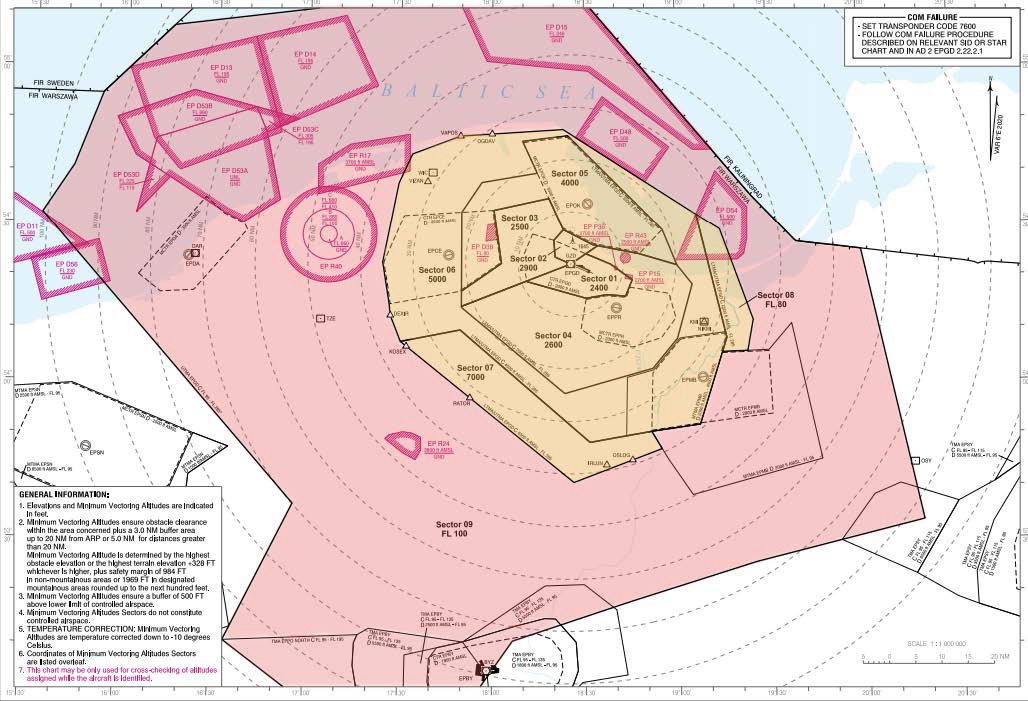
An aircraft may be vectored only within controlled airspace and above the MRVA in a given TMA sector, while avoiding prohibited and restricted areas.
Coordination with other ATC units
TWR Gdańsk
The APP Gdańsk controller remains in constant coordination with TWR Gdańsk controller.
TWR controller designate active runways for the respective airports based on the runway selection methods outlined in the Aerodrome Traffic Control Chapter of this instruction.
It is stipulated that a change of active runways should occur no earlier than 30 minutes after notifying the APP controller of the need for a change. The APP controller will then begin adjusting the arrival sequence for the new runway.
Information regarding the runway in use must always be shared among all APP controllers.
Departures from EPGD do not require an APP controller's clearance (“departure release”).
At the request of the TWR controller, the appropriate APP controller provides information on the distance in miles or time in minutes to the threshold for arriving traffic, to improve runway efficiency.
TWR Bydgoszcz
The TWR Bydgoszcz controller is responsible for procedural control within TMA Bydgoszcz (FL135).
The TWR Bydgoszcz controller coordinates with the APP Gdańsk controller regarding the departure conditions for aircraft whose route passes through TMA Gdańsk. Clearances for aircraft departing from Bydgoszcz Airport toward TMA Gdańsk include a climb up to FL100.
Control transfer should take place at the boundary of TMA, both from TWR Bydgoszcz to APP Gdańsk and from APP Gdańsk to TWR Bydgoszcz.
APP Poznań
Due to the proximity of Poznań/Ławica Airport [EPPO] and the altitude of UTMA Gdańsk, arrivals from the north to EPPO cross the UTMA Gdańsk airspace. ACC Warszawa will descend aircraft to an initial descent level of no lower than FL290 for arrivals via DEKUT.
The APP Gdańsk controller may also authorize descent directly through ACC Warszawa and specify whether they wish to receive control and communication transfer. Descent cases by ACC Warszawa within TMA Gdańsk should be considered individually for each arrival from the east to EPPO.